HiggsML package
HiggsML.datasets module
- class HiggsML.datasets.Data(input_dir, test_size=0.3)
Bases:
objectA class to represent a dataset.
- Parameters:
input_dir (str): The directory path of the input data.
- Attributes:
__train_set (dict): A dictionary containing the train dataset.
__test_set (dict): A dictionary containing the test dataset.
input_dir (str): The directory path of the input data.
- Methods:
load_train_set(): Loads the train dataset.
load_test_set(): Loads the test dataset.
get_train_set(): Returns the train dataset.
get_test_set(): Returns the test dataset.
delete_train_set(): Deletes the train dataset.
get_syst_train_set(): Returns the train dataset with systematic variations.
- delete_train_set()
Deletes the train dataset.
- get_test_set()
Returns the test dataset.
- Returns:
dict: The test dataset.
- get_train_set()
Returns the train dataset.
- Returns:
dict: The train dataset.
- HiggsML.datasets.download_dataset(input_str)
Downloads and extracts the Neurips 2024 public dataset.
- Returns:
Data: The path to the extracted input data.
- Raises:
HTTPError: If there is an error while downloading the dataset. FileNotFoundError: If the downloaded dataset file is not found. zipfile.BadZipFile: If the downloaded file is not a valid zip file.
HiggsML.ingestion module
- class HiggsML.ingestion.Ingestion(data=None)
Bases:
objectClass for handling the ingestion process.
- Args:
data (object): The data object.
- Attributes:
start_time (datetime): The start time of the ingestion process.
end_time (datetime): The end time of the ingestion process.
model (object): The model object.
data (object): The data object.
- fit_submission()
Fit the submitted model.
- get_duration()
Get the duration of the ingestion process.
- Returns:
timedelta: The duration of the ingestion process.
- init_submission(Model, model_type='sample_model')
Initialize the submitted model.
- Args:
Model (object): The model class.
- load_train_set(**kwargs)
Load the training set.
- Returns:
object: The loaded training set.
- predict_submission(test_settings, initial_seed=31415)
Make predictions using the submitted model.
- Args:
test_settings (dict): The test settings.
- save_duration(output_dir=None)
Save the duration of the ingestion process to a file.
- Args:
output_dir (str): The output directory to save the duration file.
- save_result(output_dir=None)
Save the ingestion result to files.
- Args:
output_dir (str): The output directory to save the result files.
- show_duration()
Show the duration of the ingestion process.
- start_timer()
Start the timer for the ingestion process.
- stop_timer()
Stop the timer for the ingestion process.
HiggsML.systematics module
This module contains the systematics functions for the FAIR Challenge. Originally written by David Rousseau, and Victor Estrade.
- class HiggsML.systematics.V4(apx=0.0, apy=0.0, apz=0.0, ae=0.0)
Bases:
objectA simple 4-vector class to ease calculation
- copy()
Copy the current V4 object
- Parameters:
None
- Returns:
copy (V4): a copy of the current V4 object
- deltaEta(v)
Compute the pseudo-rapidity difference with another V4 object
- Parameters:
v (V4): the other V4 object
- Returns:
deltaPhi (float): azimuthal angle difference
- deltaPhi(v)
Compute the azimuthal angle difference with another V4 object Parameters: v (V4) - the other V4 object Returns: deltaPhi (float) - azimuthal angle difference
- deltaR(v)
Compute the delta R with another V4 object
- Parameters:
v (V4): the other V4 object
- Returns:
deltaEta (float): pseudo-rapidity difference
- eWithM(m=0.0)
Compute the energy with a given mass
- Parameters:
m (float): mass
- Returns:
e (float): energy with a given mass
- eta()
Compute the pseudo-rapidity
- Parameters:
None
- Returns:
eta (float): pseudo-rapidity
- m()
Compute the mass
- Parameters:
None
- Returns:
m (float): mass
- p()
Compute the norm of the 3D momentum
- Parameters:
None
- Returns:
p (float): norm of the 3D momentum
- p2()
Compute the squared norm of the 3D momentum
- Parameters:
None
- Returns:
p2 (float): squared norm of the 3D momentum
- phi()
Compute the azimuthal angle
- Parameters:
None
- Returns:
phi (float): azimuthal angle
- pt()
Compute the norm of the transverse momentum
- Parameters:
None
- Returns:
pt (float): norm of the transverse momentum
- pt2()
Compute the squared norm of the transverse momentum
- Parameters:
None
- Returns:
pt2 (float): squared norm of the transverse momentum
- scale(factor=1.0)
Apply a simple scaling
- scaleFixedM(factor=1.0)
Scale (keeping mass unchanged)
- setPtEtaPhiM(pt=0.0, eta=0.0, phi=0.0, m=0)
Re-initialize with : pt, eta, phi and m
- sum(v)
Add another V4 into self
- HiggsML.systematics.all_bkg_weight_norm(weights, label, systBkgNorm)
Apply a scaling to the weight.
- Args:
weights (array-like): The weights to be scaled label (array-like): The labels systBkgNorm (float): The scaling factor
- Returns:
array-like: The scaled weights
- HiggsML.systematics.diboson_bkg_weight_norm(weights, detailedlabel, systBkgNorm)
Apply a scaling to the weight. For Diboson background
- Args:
weights (array-like): The weights to be scaled
detailedlabel (array-like): The detailed labels
systBkgNorm (float): The scaling factor
- Returns:
array-like: The scaled weights
- HiggsML.systematics.get_bootstrapped_dataset(test_set, mu=1.0, seed=31415, ttbar_scale=None, diboson_scale=None, bkg_scale=None, poisson=True)
Generate a bootstrapped dataset
- Args:
test_set (dict): The original test dataset
mu (float): The scaling factor for htautau background
seed (int): The random seed
ttbar_scale (float): The scaling factor for ttbar background
diboson_scale (float): The scaling factor for diboson background
bkg_scale (float): The scaling factor for other backgrounds
- Returns:
pandas.DataFrame: The bootstrapped dataset
- HiggsML.systematics.mom4_manipulate(data, systTauEnergyScale, systJetEnergyScale, soft_met, seed=31415)
Manipulate primary inputs : the PRI_had_pt PRI_jet_leading_pt PRI_jet_subleading_pt and recompute the others values accordingly.
- Args:
data (pandas.DataFrame): The dataset to be manipulated
systTauEnergyScale (float): The factor applied to PRI_had_pt
systJetEnergyScale (float): The factor applied to all jet pt
soft_met (float): The additional soft MET energy
seed (int): The random seed
- Returns:
pandas.DataFrame: The manipulated dataset
- HiggsML.systematics.postprocess(data)
Select the events with the following conditions: * PRI_had_pt > 26 * PRI_jet_leading_pt > 26 * PRI_jet_subleading_pt > 26 * PRI_lep_pt > 20
This is applied to the dataset after the systematics are applied
- Args:
data (pandas.DataFrame): The manipulated dataset
- Returns:
pandas.DataFrame: The postprocessed dataset
- HiggsML.systematics.systematics(data_set=None, tes=1.0, jes=1.0, soft_met=0.0, seed=31415, ttbar_scale=None, diboson_scale=None, bkg_scale=None, dopostprocess=True)
Apply systematics to the dataset
- Args:
data_set (dict)/(df): The dataset to apply systematics to
tes (float): The factor applied to PRI_had_pt
jes (float): The factor applied to all jet pt
soft_met (float): The additional soft MET energy
seed (int): The random seed
ttbar_scale (float): The scaling factor for ttbar background
diboson_scale (float): The scaling factor for diboson background
bkg_scale (float): The scaling factor for other backgrounds
- Returns:
dict: The dataset with applied systematics
- HiggsML.systematics.ttbar_bkg_weight_norm(weights, detailedlabel, systBkgNorm)
Apply a scaling to the weight. For ttbar background
- Args:
weights (array-like): The weights to be scaled
detailedlabel (array-like): The detailed labels
systBkgNorm (float): The scaling factor
- Returns:
array-like: The scaled weights
HiggsML.derived_quantities module
This module contains the functions to calculate the derived quantities of the HEP dataset. Originally written by David Rousseau, and Victor Estrade.
- HiggsML.derived_quantities.DER_data(data)
data is supposed to be clean (no Weight, no eventId etc…) This function directly modifies the dataframe data so make sure to make a copy if you need to keep data
- HiggsML.derived_quantities.calcul_int(data)
Calculate the px py pz E components of the particles’ 4 momentum.
- Args:
data (pandas.DataFrame): Input data containing the particle properties.
- Returns:
pandas.DataFrame: Dataframe with the derived quantities calculated.
- HiggsML.derived_quantities.f_DER_deltaeta_jet_jet(data)
Calculate the absolute value of the difference of the pseudorapidity of the two jets Parameters: data (dataframe)
- HiggsML.derived_quantities.f_DER_deltar_had_lep(data)
Calculate the delta R between the hadron and the lepton
- HiggsML.derived_quantities.f_DER_lep_eta_centrality(data)
Calculate the centrality of the lepton Parameters: data (dataframe)
- HiggsML.derived_quantities.f_DER_mass_jet_jet(data)
Calculate the invariant mass of the two jets Parameters: data (dataframe)
- HiggsML.derived_quantities.f_DER_mass_transverse_met_lep(data)
Calculate the transverse mass between the MET and the lepton Parameters: data (dataframe)
- HiggsML.derived_quantities.f_DER_mass_vis(data)
Calculate the invariant mass of the hadron and the lepton Parameters: data (dataframe)
- HiggsML.derived_quantities.f_DER_met_phi_centrality(data)
Calculate the centrality of the MET Parameters: data (dataframe)
- HiggsML.derived_quantities.f_DER_prodeta_jet_jet(data)
Calculate the product of the pseudorapidities of the two jets Parameters: data (dataframe)
- HiggsML.derived_quantities.f_DER_pt_h(data)
Calculate the transverse momentum of the hadronic system Parameters: data (dataframe)
- HiggsML.derived_quantities.f_DER_pt_ratio_lep_had(data)
Calculate the ratio of the transverse momentum of the lepton and the hadron Parameters: data (dataframe)
- HiggsML.derived_quantities.f_DER_pt_tot(data)
Calculate the total transverse momentum Parameters: data (dataframe)
- HiggsML.derived_quantities.f_DER_sum_pt(data)
Calculate the sum of the transverse momentum of the lepton, the hadron and the jets Parameters: data (dataframe)
- HiggsML.derived_quantities.f_del_DER(data)
Delete all the unnecessary columns that were used to calculate the DER variables Parameters: data (dataframe)
HiggsML.score module
- class HiggsML.score.Scoring
Bases:
objectThis class is used to compute the scores for the competition. For more details, see the evaluation page.
- Atributes:
start_time (datetime): The start time of the scoring process.
end_time (datetime): The end time of the scoring process.
ingestion_results (list): The ingestion results.
ingestion_duration (float): The ingestion duration.
scores_dict (dict): The scores dictionary.
- Methods:
start_timer(): Start the timer.
stop_timer(): Stop the timer.
get_duration(): Get the duration of the scoring process.
show_duration(): Show the duration of the scoring process.
load_ingestion_duration(ingestion_duration_file): Load the ingestion duration.
load_ingestion_results(prediction_dir=”./”,score_dir=”./”): Load the ingestion results.
compute_scores(test_settings): Compute the scores.
RMSE_score(mu, mu_hat, delta_mu_hat): Compute the RMSE score.
MAE_score(mu, mu_hat, delta_mu_hat): Compute the MAE score.
Quantiles_Score(mu, p16, p84, eps=1e-3): Compute the Quantiles Score.
write_scores(): Write the scores.
save_figure(mu, p16s, p84s, set=0): Save the figure.
- MAE_score(mu, mu_hat, delta_mu_hat)
Compute the mean absolute error between the true value mu and the predicted value mu_hat.
- Args:
mu (float): The true value.
mu_hat (np.array): The predicted value.
delta_mu_hat (np.array): The uncertainty on the predicted value
- Quantiles_Score(mu, p16, p84, eps=0.001)
Compute the quantiles score based on the true value mu and the quantiles p16 and p84.
- Args:
mu (array): The true ${mu} value.
p16 (array): The 16th percentile.
p84 (array): The 84th percentile.
eps (float, optional): A small value to avoid division by zero. Defaults to 1e-3.
- RMSE_score(mu, mu_hat, delta_mu_hat)
Compute the root mean squared error between the true value mu and the predicted value mu_hat.
- Args:
mu (float): The true value.
mu_hat (np.array): The predicted value.
delta_mu_hat (np.array): The uncertainty on the predicted value.
- compute_scores(test_settings)
Compute the scores for the competition based on the test settings.
- Args:
test_settings (dict): The test settings.
- load_ingestion_duration(ingestion_duration_file)
Load the ingestion duration.
- Args:
ingestion_duration_file (str): The ingestion duration file.
- load_ingestion_results(prediction_dir='./', score_dir='./')
Load the ingestion results.
- Args:
prediction_dir (str, optional): location of the predictions. Defaults to “./”. score_dir (str, optional): location of the scores. Defaults to “./”.
- save_figure(mu, p16s, p84s, set=0, true_mu=None, result_text=None)
Save the figure of the mu distribution.
- Args:
mu (array): The true ${mu} value.
p16 (array): The 16th percentile.
p84 (array): The 84th percentile.
set (int, optional): The set number. Defaults to 0.
HiggsML.visualization module
- HiggsML.visualization.correlation_plots(dfall, target, columns=None)
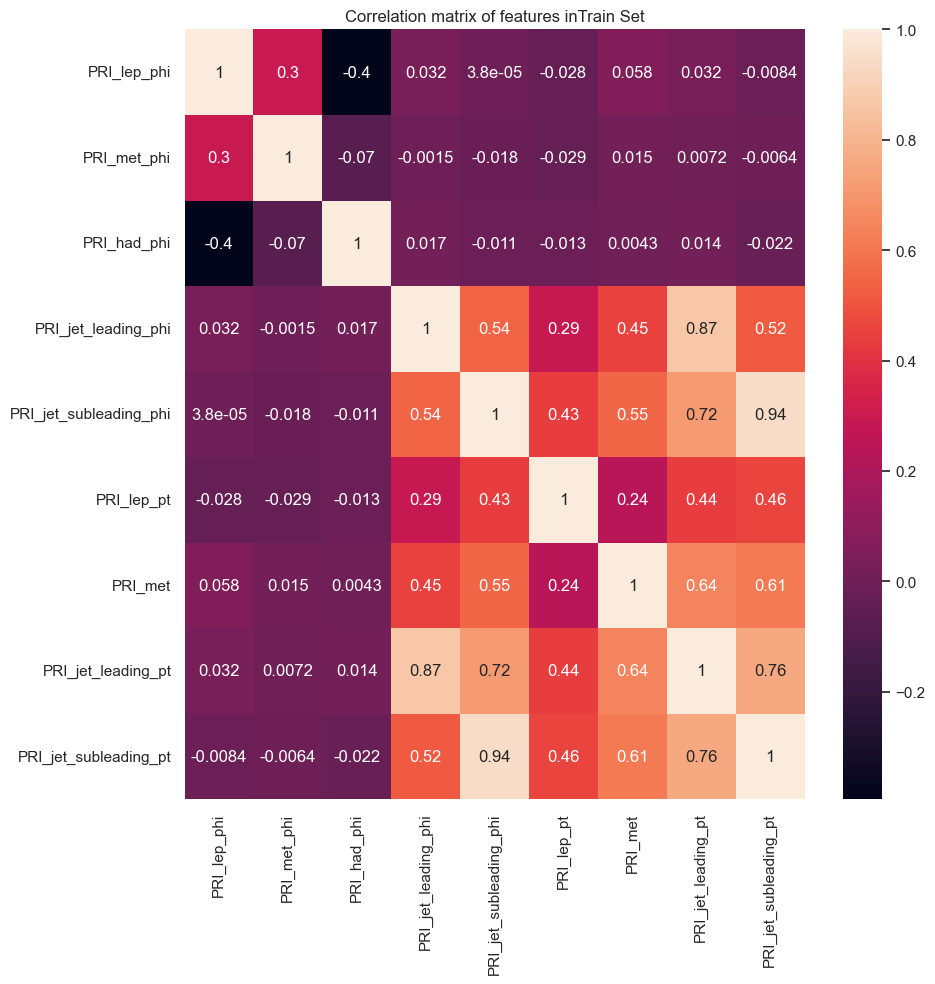
Plots correlation matrices of the dataset features.
Args: * dfall : Pandas Dataframe * target : numpy array with labels * columns : List of column names to consider
- HiggsML.visualization.event_vise_syst(dfall, df_syst, columns=None, sample_size=100)
Plots the event-wise shift between the nominal dataset and the systemalically shifted dataset. Args:
dfall : The nominal dataset.
df_syst : The systematics shifted dataset.
sample_size : The number of samples to consider (default: 100).
columns : The list of column names to consider.
..Images:: ../images/event_vise_syst.png
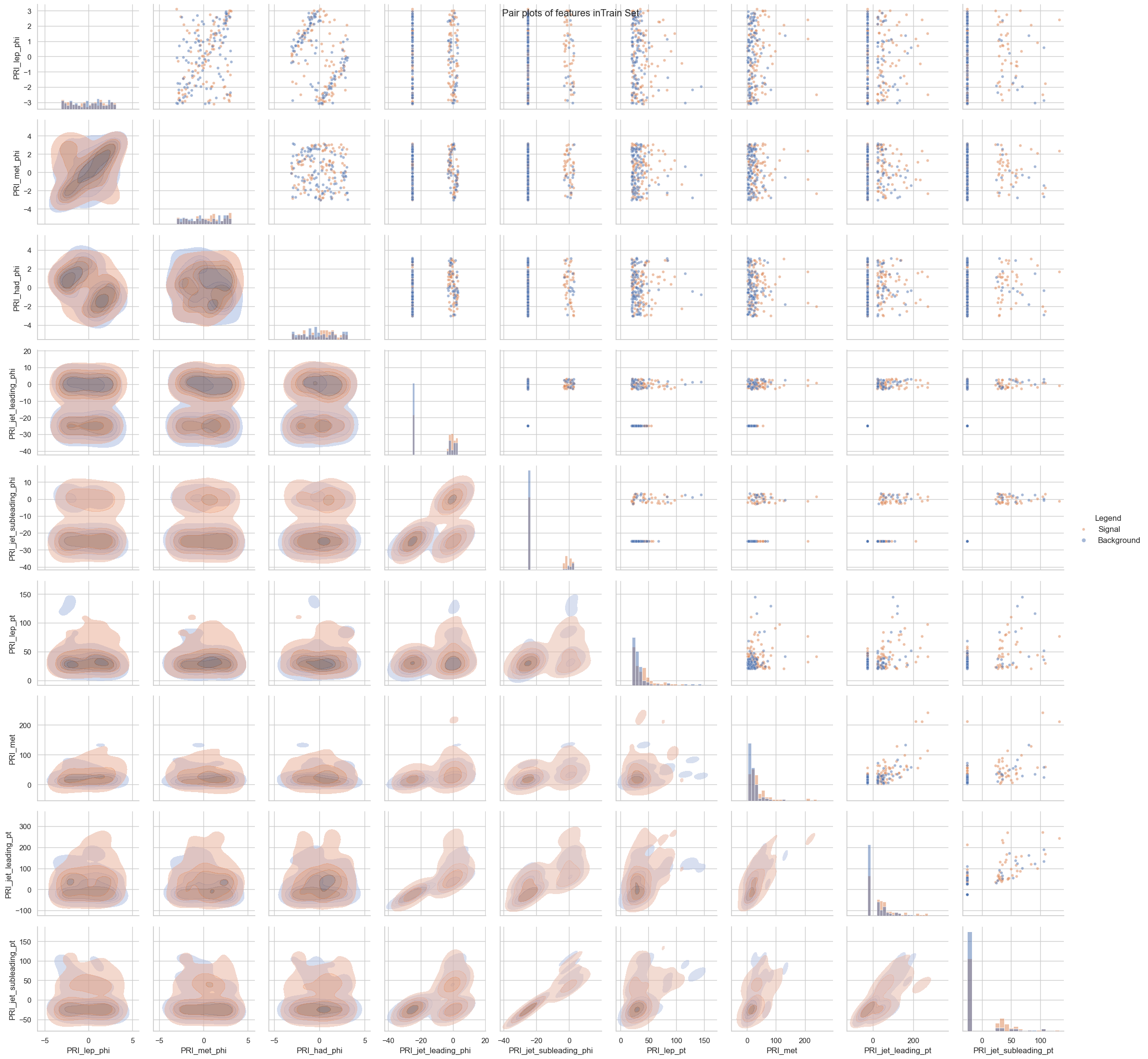
- HiggsML.visualization.pair_plots(dfall, target, sample_size=10, columns=None)
Plots pair plots of the dataset features.
- Args:
target : numpy array with labels
sample_size (int): The number of samples to consider (default: 10).
columns : List of column names to consider
- HiggsML.visualization.pair_plots_syst(dfall, df_syst, sample_size=100, columns=None)
Plots pair plots between the dataset and a system dataset.
- Args:
df_syst (DataFrame): The system dataset.
sample_size (int): The number of samples to consider (default: 10).
..images:: ../images/pair_plot_syst.png
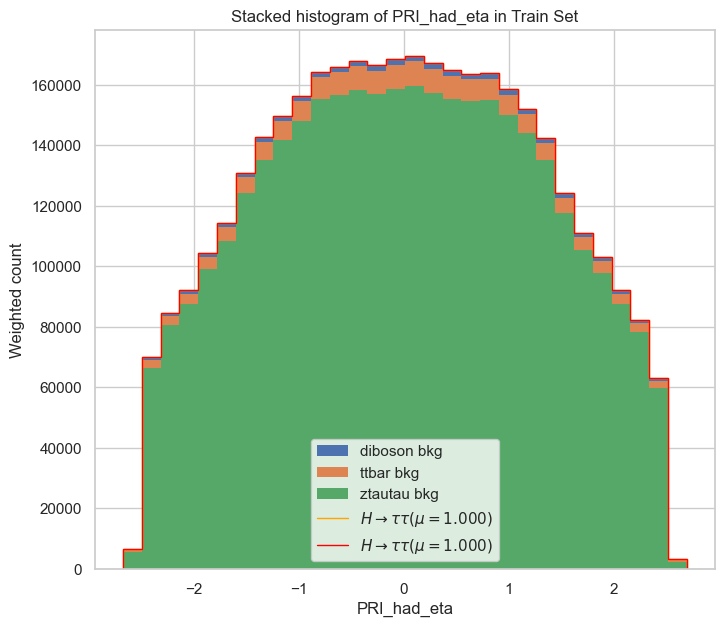
- HiggsML.visualization.stacked_histogram(dfall, target, weights, detailed_label, field_name, mu_hat=1.0, nbins=30, y_scale='linear')
Plots a stacked histogram of a specific field in the dataset.
- Args:
dfall : Pandas Dataframe
target : numpy array with labels
weights : numpy array with event weights
weights : numpy array with detailed labels of the events
detailed_label : The name of the field to plot.
mu_hat : The value of mu (default: 1.0).
bins (int): The number of bins for the histogram (default: 30).
- HiggsML.visualization.visualize_coverage(ingestion_result_dict, ground_truth_mus)
Plots a coverage plot of the mu values.
- Args:
ingestion_result_dict : A dictionary containing the ingestion results.
ground_truth_mus : A dictionary of ground truth mu values.

- HiggsML.visualization.visualize_scatter(ingestion_result_dict, ground_truth_mus)
Plots a scatter Plot of ground truth vs. predicted mu values.
- Args:
ingestion_result_dict : A dictionary containing the ingestion results.
ground_truth_mus : A dictionary of ground truth mu values.
